
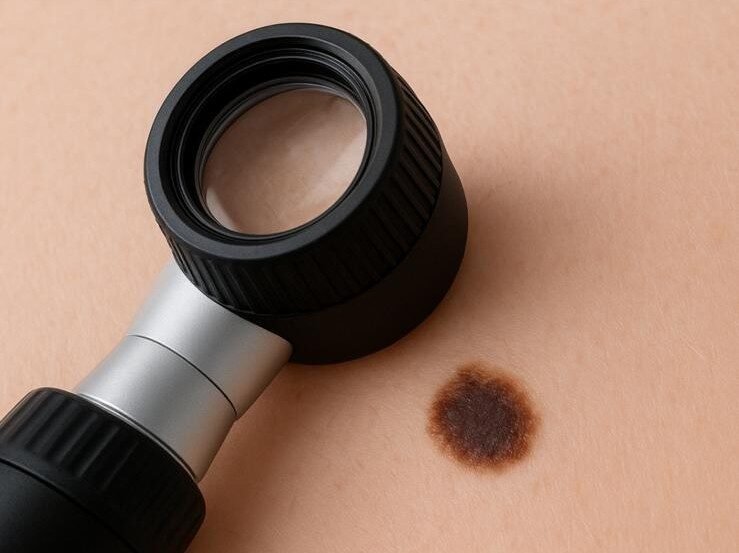
After the summer holidays, we see many different types of spots in our practice. On the one hand, new spots may appear due to excessive sun exposure, called actinic lentigines, these appear as well-defined brown patches. Hormonal spots, such as melasma may appear, possibly before sun exposure, or they may worsen existing melasma. These types of spots or melasma usually appear as more diffuse patches on the upper lip, forehead, or cheeks, although they can also appear in other locations. The appearance of these spots, as well as those due to excessive cumulative sun exposure, is a sign from our body that its antioxidant capacity has been exceeded. Melanin is an antioxidant and acts as a defense mechanism, but when the liver's capacity to eliminate free radicals produced by ultraviolet radiation or other stressors such as tobacco, electromagnetic radiation, etc., is exceeded through the production of neutralizing antioxidants, spots will appear. Therefore, in addition to local treatment with lasers or other methods, it is useful to combine a program of detoxification.
On the other hand, there are spots related to photoaging of the skin that have a rougher surface. These are called actinic keratoses which should be treated since they can progress to skin cancer (scaly carcinomas). We must not forget skin cancer most dangerous of the skin,the malignant melanoma that can appear as a new pigmented lesion or as a lentigo that has changed: in its symmetry (asymmetry), borders, color, diameter, and evolution. This is the ABCDE rule of MM. Additionally, benign, rough, dark spots may appear, called seborrheic keratoses. Other types of spots that can appear after sun exposure are due to the application of certain creams, contact with plants, or perfumes. These are the contact dermatitis. Certain superficial fungal skin infections can appear as pink, white, or brownish patches on the skin, especially on the back and chest. These are the pityriasis versicolor.
We must not forget that the same stress itself, through the simultaneous release of cortisol and melanin-stimulating hormone (MSH), promotes the formation of dark spots. Certain internal diseases present with skin spots, such as Addison's disease or adrenal insufficiency. Poisoning from medications such as amiodarone or tetracyclines can also cause skin spots.
The treatment will depend on the type of blemish. Most often, several types of blemishes coexist, in which case the treatment will need to be combined. For example, in the case of solar lentigines, treatment can be performed with a specific type of laser that destroys the pigment, or in other cases where other vascular lesions or other signs of skin aging are present, treatment with intense pulsed light (IPL) intense pulsed lightmay be an option. In cases of melasma, laser and IPL treatments should not be used as they are too aggressive and can cause an increase in the spots; instead, other treatments should be used depigmenting chemical peels along with photobiomodulationto regulate the function of melanocytes. In the case of actinic keratoses, often associated with actinic lentigines or sunspots, the lesion must be removed, and the entire face or scalp must also be treated to eliminate asymptomatic lesions that are not yet visible but may appear in the near future. For this, the most useful approach is to use sequential therapy that combines different topical treatments with photodynamic therapy to destroy the atypical cells.
The number of treatment sessions will depend on the type of blemish. Many solar lentigines can disappear after a single laser session, while melasma, being a chronic condition, will require many more sessions of peels and photobiomodulation, in addition to constant sun protection.
Prevention is crucial to avoid the appearance of blemishes and skin aging in general. In fact, the appearance of blemishes is just the tip of the iceberg, the visible sign of skin damage that has been accumulating over the years. The most important preventative measure is sun protection from childhood, as the development of skin cancer has been correlated with sunburns suffered in childhood. Sun exposure should be gradual, avoiding the sun between 11 a.m. and 5 p.m. in summer. Depending on the skin phototype, that is, the skin's ability to react to sunlight, a higher or lower level of sun protection will be necessary. Second, it is important to use moisturizers suitable for each skin type and to maintain a proper daily cleansing routine. Third, a balanced diet rich in antioxidants is also beneficial for preventing skin aging. In certain cases of very sensitive skin, it may be advisable to add dietary supplements with beta-carotene, lycopene, vitamin C and E, astaxanthin, silicon, polypodium leucotomus, and bioflavonoids, among others.
To prevent the appearance of dark spots, photobiomodulation therapy is useful because it helps block the harmful effects of ultraviolet radiation on the skin. Between 8 and 10 photobiomodulation sessions will give the skin the equivalent of an SPF 15 sunscreen. This therapy is painless. Its cellular mechanism acts directly on the cell nucleus and mitochondria, regulating cellular functions and energy. Therefore, it can be considered a true anti-aging treatment that can also be combined with all other existing techniques for combating skin aging.
KEY WORDS:
Actinic lentigines, melasma, hormonal spots, skin aging, skin cancer, malignant melanoma, fungi, photobiomodulation, laser, IPL, photodynamic therapy, chemical peels, antioxidants, detoxification, sun protection
SUMMARY
I explain the multiple causes of skin blemishes. A dermatologist should diagnose these lesions using dermatoscopy to determine their exact cause.
Causes:
Ultraviolet radiation, stress, hormonal imbalances, skin aging, fungal infections, internal diseases, poisoning.
Treatment: laser, IPL, photodynamic therapy, biomodulation (low-intensity light therapy), chemical peels, antioxidants, detoxification, sun protection