
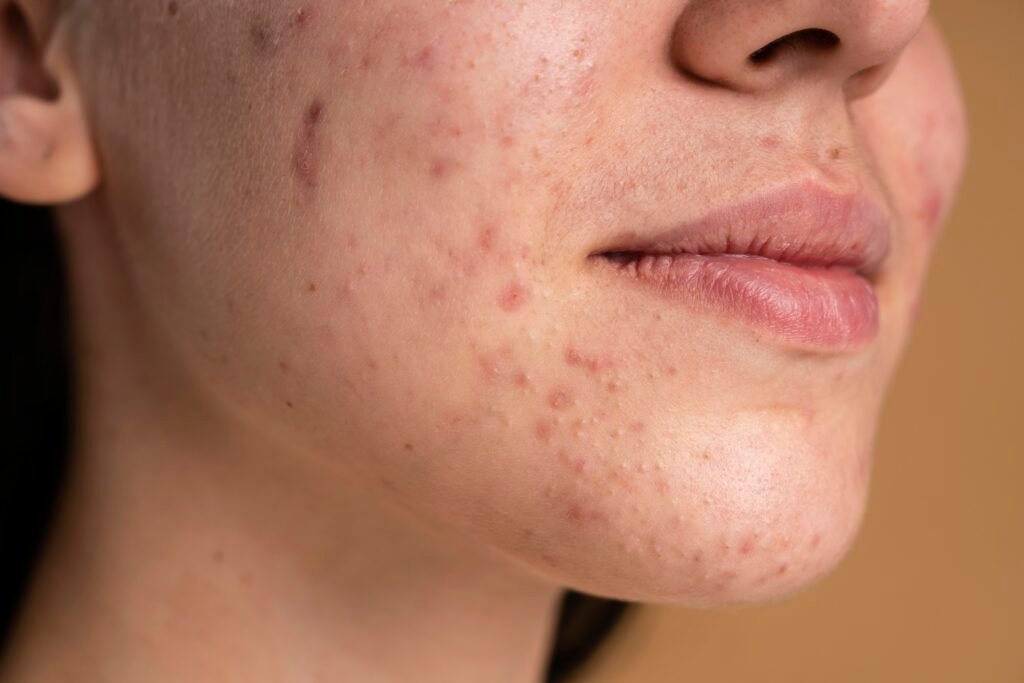
Acne isn't always just a hormonal or skin issue. We're seeing more and more patients in our practice whose acne appears or worsens during times of emotional stress.
If this has happened to you—breakouts before a big event, during times of anxiety or fatigue—it’s no coincidence.
In this article, I’ll explain—from both a dermatological and an integrative perspective—what’s really happening in your skin and how to address it effectively.
CAN STRESS CAUSE ACNE?
Yes. And it doesn't just make it worse—in some cases, it can be the main trigger.
Stress triggers a series of mechanisms in the body that directly affect the skin:
- Increased cortisol (the stress hormone)
- Increased oil production in the skin
- Inflammation
- Disruption of the immune system
All of this creates the perfect environment for acne to develop.
WHAT EXACTLY HAPPENS TO THE SKIN?
When you're under prolonged stress, your body goes into “alert” mode. This causes:
1. Increased sebum production
The sebaceous glands become active → the skin becomes oilier → the pores become clogged.
2. Inflammation
Stress promotes inflammation → pimples become redder, more painful, and last longer.
3. Alteration of the skin microbiome
The skin loses its balance → bacteria associated with acne begin to multiply.
4. Reduced ability to heal
The skin takes longer to heal → wounds take longer to heal.
HOW CAN YOU TELL IF IT'S STRESS-RELATED ACNE?
Although it may resemble other types of acne, it usually has certain characteristics:
- Sudden outbursts during tense moments
- It gets worse during certain periods (work, personal problems, major life changes)
- Commonly found on the jaw, chin, or neck
- A feeling that your skin is more reactive or sensitive
Many patients say, “My skin reflects exactly how I feel.” And, in many cases, that’s true.
The skin is not an isolated organ. It is deeply connected to the nervous system and our emotional state. In fact, they share the same embryonic origin.
This means that what you experience emotionally can manifest itself on your skin. It’s not “psychological” in the sense that it’s imaginary, but rather physiological.
Chronic stress:
- disrupts hormone balance
- reduces inflammation
- alters the skin's response
That's why treating just the skin often isn't enough.
WHY DON'T TRADITIONAL TREATMENTS ALWAYS WORK?
Because they address the symptom, but not the cause.
Creams, antibiotics, or retinoids can improve acne, but if the underlying cause (stress) remains, the acne returns or does not fully clear up. This causes frustration for many patients.
HOW TO TREAT STRESS-RELATED ACNE (A COMPREHENSIVE GUIDE)
The most effective approach combines dermatology with a more comprehensive perspective.
- Appropriate dermatological treatment. Depending on the case: topical treatments, inflammation control, and sebum regulation.
- Stress management. It’s not just about “relaxing,” but about taking real action: improving sleep, reducing stress, and incorporating tools for emotional regulation.
- Personalized skincare. Stressed skin needs simple routines, avoiding excessive irritation, and products that are appropriate for the situation.
- Understanding the origin. When you understand what’s going on in your body and in your life, your skin stops being an enemy and becomes a sign.
A DIFFERENT APPROACH
In our practice, we often find that acne improves when patients understand what’s going on and their treatment is tailored to their specific situation. It’s not just about “treating pimples”—it’s about understanding the person as a whole.
WHEN SHOULD YOU SEEK MEDICAL ADVICE?
If you feel that your acne flares up or gets worse when you're stressed, if standard treatments aren't working as well as they should, or if your skin is reflecting a difficult time in your life, it may be helpful to have a more comprehensive evaluation.
CONCLUSION
Stress-related acne is real, common, and treatable. But it requires a different approach: it’s not just about the skin, but also the nervous system, hormones, and emotional well-being. When addressed holistically, the results tend to be more stable and long-lasting.
If you'd like a personalized assessment, you can consult with me online. Every skin has its own story, and understanding it is the first step toward improving it.